


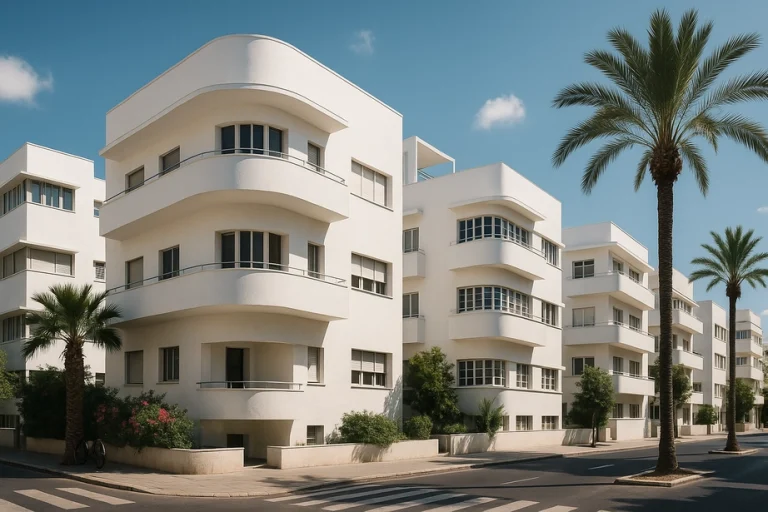
🏇 Tel Aviv’s White City: A Bauhaus Architectural Symphony Under the Mediterranean Sun
At the heart of Israel’s metropolis stretches a unique urban masterpiece — the “White City”, the world’s largest open-air museum of the International Style of the 1930s–40s. More than 4,000 buildings with white facades, strict geometry, and innovative solutions form an ensemble inscribed on the UNESCO World Heritage List in 2003 as “an outstanding example of new town planning and architecture of the early 20th century.”
🏆 The White City Phenomenon: Why UNESCO Recognized Tel Aviv
A fusion of history, ideology, and innovation
- Historical context: The city was founded in 1909 north of Jaffa. Its architectural heyday came in the 1930s–50s, when Jewish architects fleeing Nazi Europe brought modernist ideas with them. Key names include Arieh Sharon, Zeev Rechter, and Yosef Neufeld.
- Urban-planning genius: The 1929 plan by the Scotsman Sir Patrick Geddes laid the groundwork for an “organic city” with green boulevards oriented toward the sea and neighborhood “communities.”
- Adaptation to climate: European functionalism transformed under the blazing sun:
• Ribbon windows → deep balconies and loggias for shade;
• Flat roofs → terraces for evening leisure;
• Light facades → heat reflection;
• Pilotis/columns → breezy, ventilated ground floors.
“Bauhaus architecture here is a physical expression of Zionism — an attempt to build a new society.”
🚶♂️ A Walk Among Icons: From Rothschild Boulevard to the ‘Ships’
A route through must-see examples of the style
🔹 Rothschild Boulevard — the Bauhaus ‘showcase’
- Brown–Rabinsohn House (No. 82): Designed by the father-and-son Berlin team (1932). Clean lines, a “thermometer” stairwell window, and sliding louver shutters.
- Building at the corner of Shaul HaMelech: A classic of “ship” aesthetics with rounded deck-like balconies.
🔹 Dizengoff Square — the heart of modernism
- Esther Cinema (now the Cinema Hotel): A masterpiece by Genia Averbuch (1938), where pristine white forms pair with neon signage.
- Dizengoff House: Where Ben-Gurion proclaimed Israel’s independence in 1948. Today it’s the Independence Hall Museum.
🔹 1 Montefiore Street
- The “Ship House” by Itzhak (Isaac) Schwartz (1920s). A triangular prow-like facade and emphatic horizontal lines convey motion.
⚖️ Preservation vs. Development: How the City Protects Its Heritage
Between restoration and modernization
- Bauhaus Center: Founded in 2000. Organizes tours, exhibitions, and publishes books on the modernist legacy.
- Restoration challenges: About 80% of buildings are privately owned. Facade restoration can take 8–10 years and depends on owners. A success story is the Reisfeld House (96 HaYarkon St.), where glass levels were added to the historic volume.
- German–Israeli cooperation: Since 2015, Germany has invested about €2.8 million in restoration, including a center in the Max Liebling House.
- New landmarks: Skyscrapers rise near the White City (Azrieli Sarona), while in the Sarona district the business center stands alongside restored 19th-century Templar houses.
💡 Why It’s Fascinating for Every Traveler
Not just for architects!
- Retro-futurist aesthetics: Buildings look like a 1930s film set yet remain lived-in.
- Atmospheric details: Light playing across rhythmic facades, pergola shadows on rooftops, cafés at street level.
- Pedestrian scale: Streets are made for walking. Shaded Rothschild Boulevard is ideal for leisurely viewing.
- Bridging eras: From the socialist ideals of the 1930s to today’s “city that never sleeps.”
✨ Conclusion: Tel Aviv as a Museum of Frozen Music
The “White City” isn’t a frozen monument but a living organism — laundry on balconies, sunset wine on flat roofs. It’s a symphony of concrete and light, where every detail reminds you: modernism wasn’t merely copied here — it was brilliantly reimagined. For Israel, these houses became a manifesto of new identity; for the world, a lesson in adapting the avant-garde to place and time.
🔍 Want to See the Legendary Bauhaus?
📅 Shato Tours offers tailor-made tours with architects:
- A map of “100 Buildings of the White City”
- Visits to restored interiors
- Stories of families who lived in these “modernist icons”
“Architecture is frozen music in space” (Friedrich Schelling). In Tel Aviv, it resonates with exceptional power.