


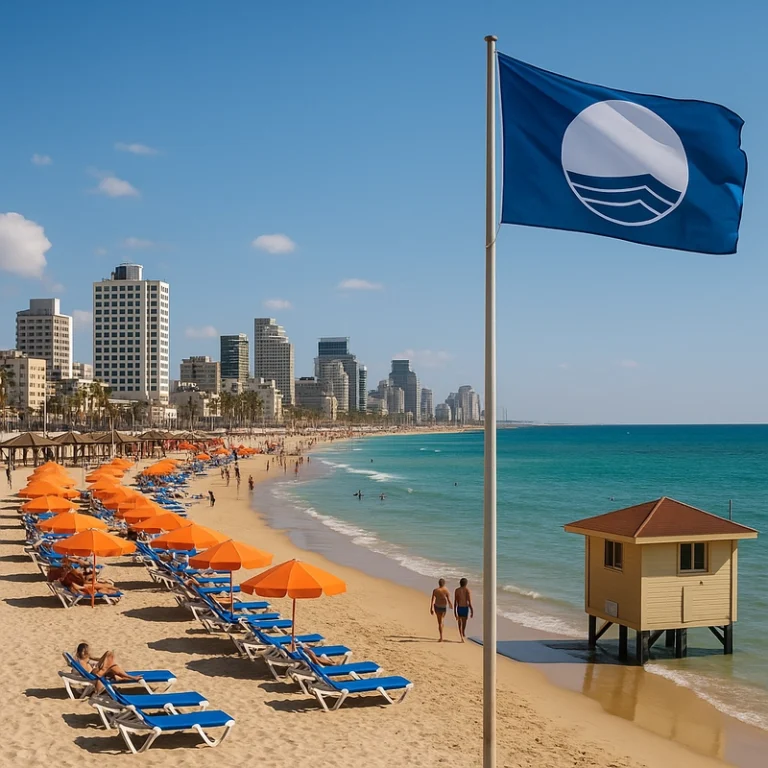
The city has set an impressive environmental record! All 13 municipal beaches of Tel Aviv have received the prestigious international Blue Flag award for 2025 — for the thirteenth year in a row. This isn’t a mere formality – it’s a mark of top-tier quality, safety, and environmental responsibility that directly enhances your beach experience. Let’s unpack what stands behind this symbol and how it changes a day at the beach.
🏆 Blue Flag: More Than Just a Pennant
Awarded by the international Foundation for Environmental Education (FEE), the Blue Flag is a guarantee of compliance with 37 stringent criteria across four key pillars:
🌊 Water & Ecology: Impeccable quality of seawater and sand (regular monitoring), no industrial discharges, protection of coastal ecosystems.
🛟 Safety: Qualified lifeguards on duty, equipped first-aid stations, clear emergency action plans, safe bathing conditions.
♿ Accessibility: Dedicated infrastructure for people with disabilities (ramps, amphibious beach wheelchairs, adapted showers and restrooms).
📚 Eco-education & Management: Information on local flora and fauna, beach rules, waste management, and overarching environmental policy.
Important: The award is granted annually. That means Tel Aviv’s beaches haven’t just passed a one-time inspection — they continuously maintain and improve their standards under close international oversight.
🔄 What’s New with the 2025 Award? A Focus on Sustainability
Securing the Blue Flag in 2025 is the result of proactive steps by the city and beach operators. Key updates and enhancements include:
🚫 Stronger action on plastics:
— The ban on single-use plastic bags and tableware in bathing zones is enforced more strictly.
— More signage reminds visitors of the ban.
— Alternatives promoted: water refill stations for reusable bottles; biodegradable tableware in beach cafés.
🔬 Enhanced environmental monitoring:
— Increased frequency of water and sand sampling for lab analysis, ensuring consistent cleanliness.
— Test results are promptly published on official city channels and in mobile apps to keep visitors informed.
♻️ Upgraded sustainability infrastructure:
— Additional separate waste bins installed (plastics, paper, general waste).
— Showers and restrooms modernized to significantly reduce water consumption.
📢 Eco-education scaled up:
— Expanded educational programs for all ages, especially children (talks, workshops, interactive displays).
— Stronger partnerships with environmental organizations (e.g., EcoOcean) for joint projects.